IEPE to MQTT Vibration Data Source
Model: VDS130
The VDS130 is a 4-channel IEPE to MQTT converter that functions as a vibration data source for MQTT-based IIoT platforms, vibration monitoring and analytics, and cloud-based data systems.
Key features and benefits
- 4 IEPE input channels – consolidate multiple vibration points in a single device with option for time-synchronization using tachometer (RPM) input for applications requiring rotational speed reference
- Preserves analog signal resolution – vibration spectrum and FFT data up to 40 kHz, no compromise on data quality
- Trending with calculated vibration metrics – multiple bandwidths including ISO-defined frequency ranges for acceleration, velocity, and displacement, plus true peak, crest factor, and standard deviation
- Broad sensor compatibility – supports general purpose, high-frequency, low-frequency, harsh-environment, and hazardous-location accelerometers
- Ideal for retrofits and new installations – whether upgrading legacy vibration monitoring or deploying a new digital architecture, the VDS130 seamlessly bridges trusted IEPE sensors with MQTT-based platforms.
Specifications
Physical and environmental specifications for the VDS130
- Power requirement: 24 VDC
- Power consumption: 10 W max.
- Exterior material: aluminum (painted)
- Operating temperature: –10 to +80 °C
- Dimensions: 120mm x 155mm x 34mm
- Weight: 420 grams
- Mounting: optional DIN rail adapter for back- or side-mounting
Device Center
Device Center Overview
The VDS Device Center is a built-in, browser-based interface used to configure, monitor, and maintain the VDS130. It allows users to set network and MQTT parameters, configure per-channel measurement settings, and manage user access. An MQTT viewer shows exactly what data the device is publishing. The Device Center also supports software, firmware, and system updates, enabling commissioning and ongoing device management without external tools.
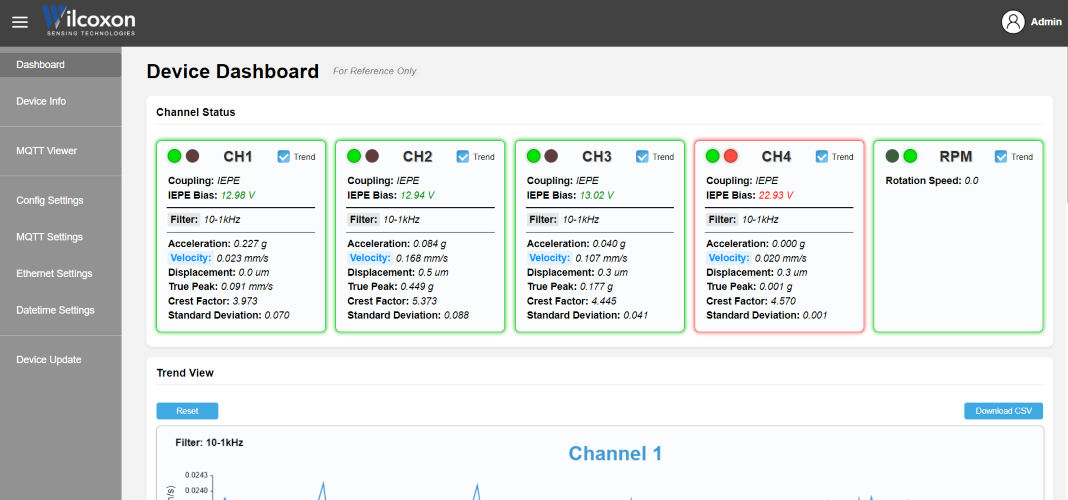
The dashboard provides live status indicators for each sensor and input channel, reflecting device and signal functionality rather than the condition of the monitored asset. These indicators confirm proper sensor operation, connectivity, and configuration. The Device Center does not perform asset health monitoring, trending, alarming, or diagnostic analysis
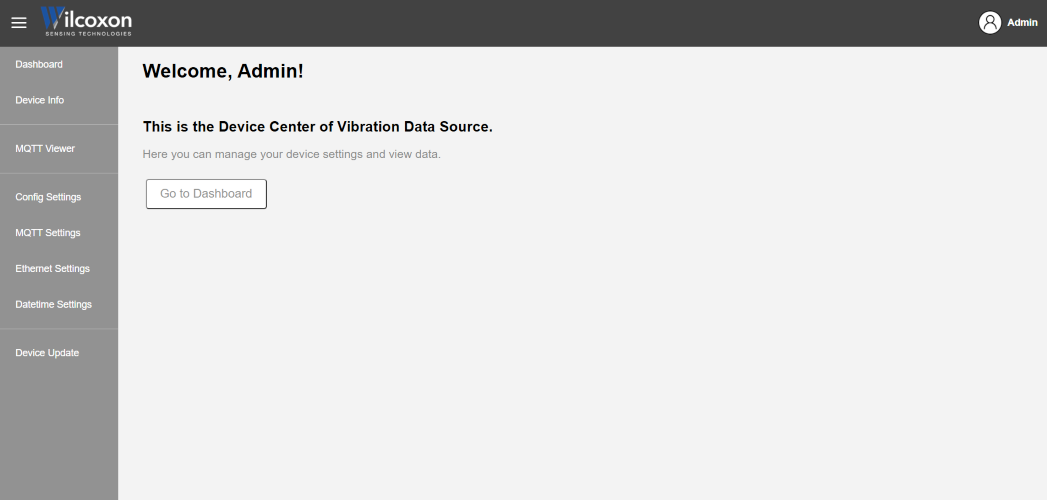
VDS130 Device Center: Welcome Admin
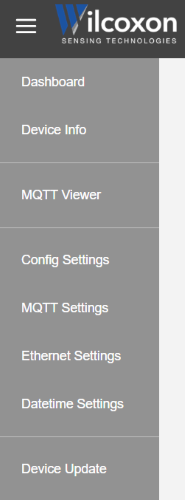
VDS130 Device Center: left hand navigation
VDS130 Device Center: Dashboard
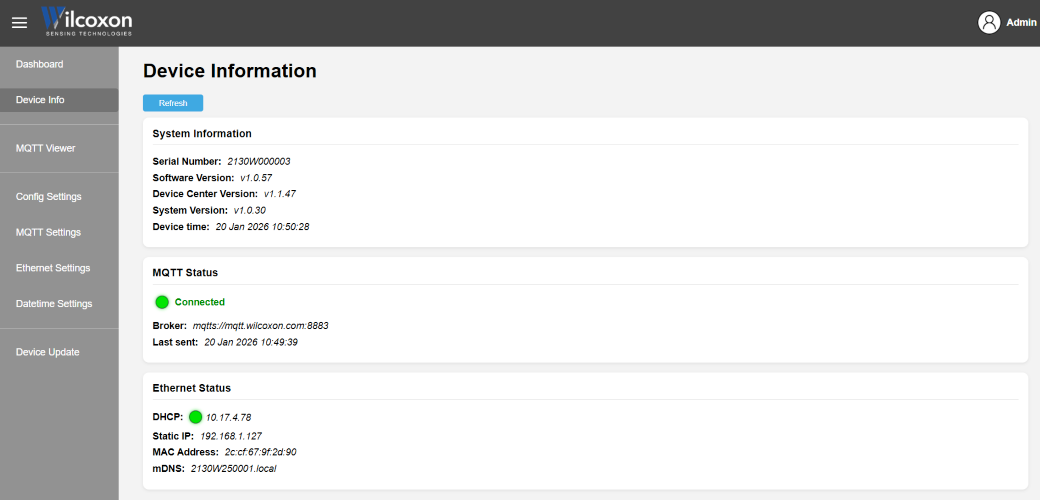
VDS130 Device Center: Device Information
VDS130 Device Center: MQTT Viewer calculated metrics
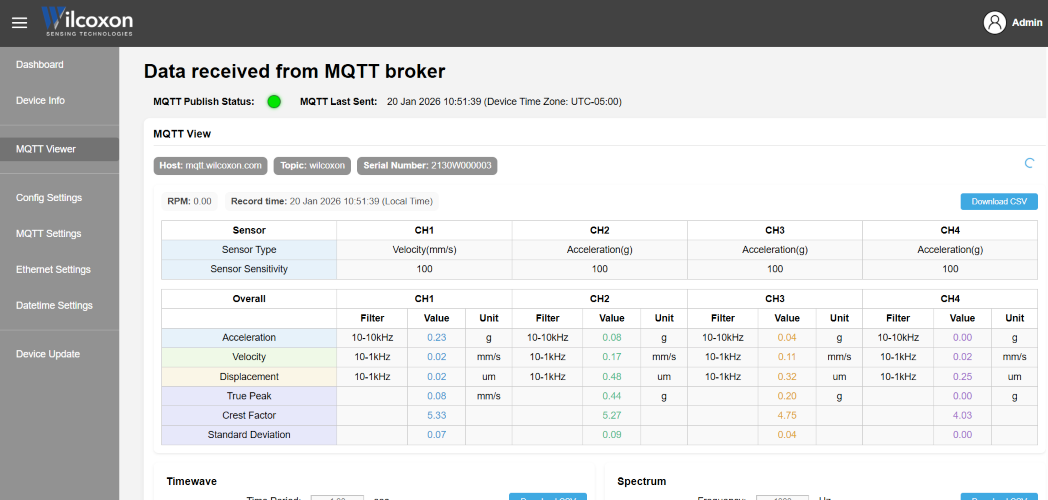
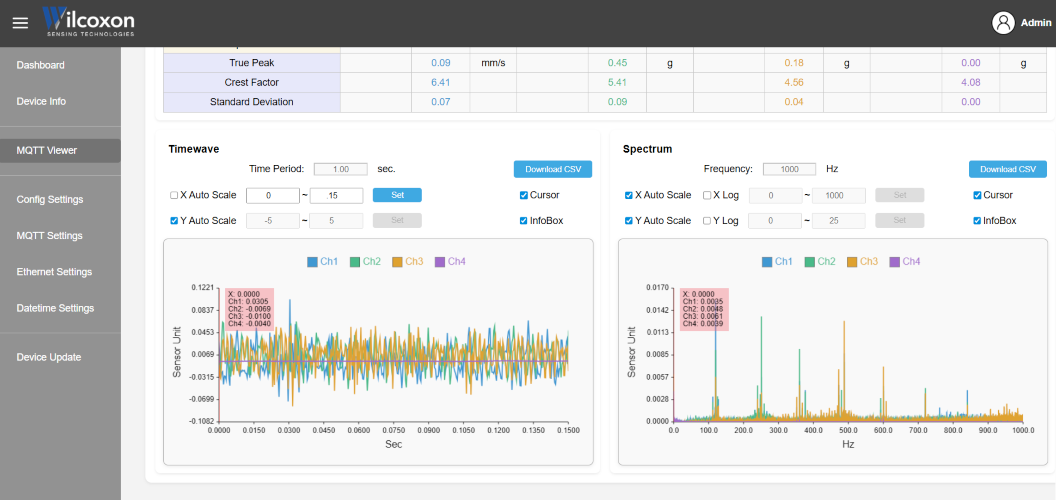
VDS130 Device Center: MQTT Viewer waveform and spectrum
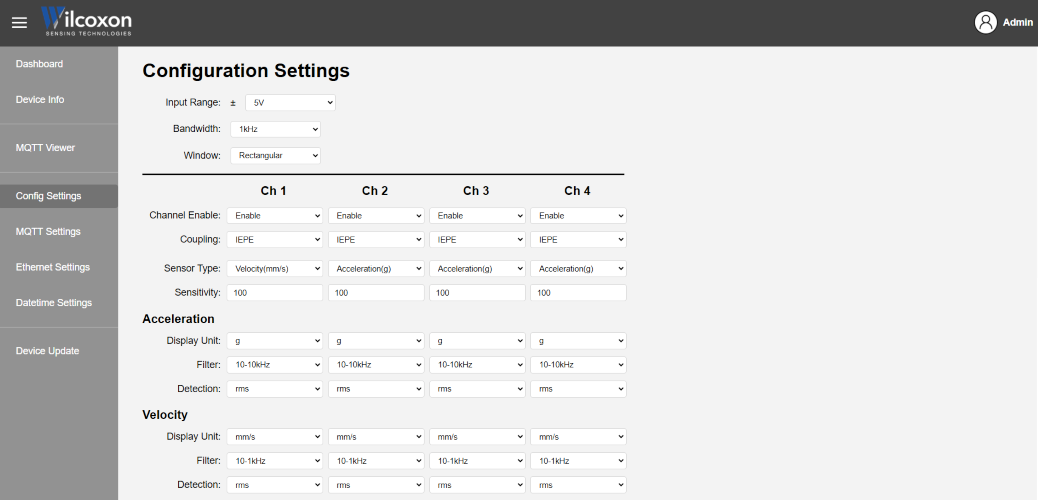
VDS130 Device Center: Configuration Settings
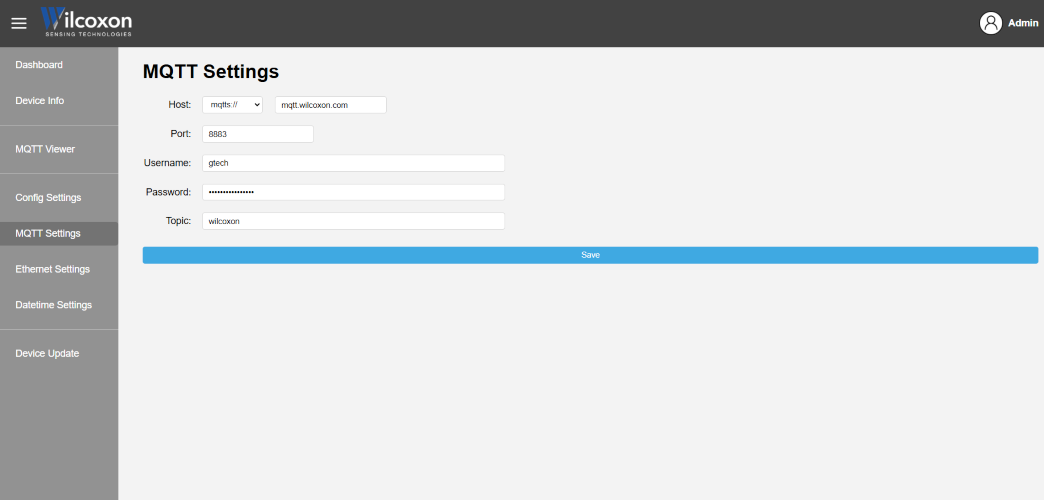
VDS130 Device Center: MQTT Settings
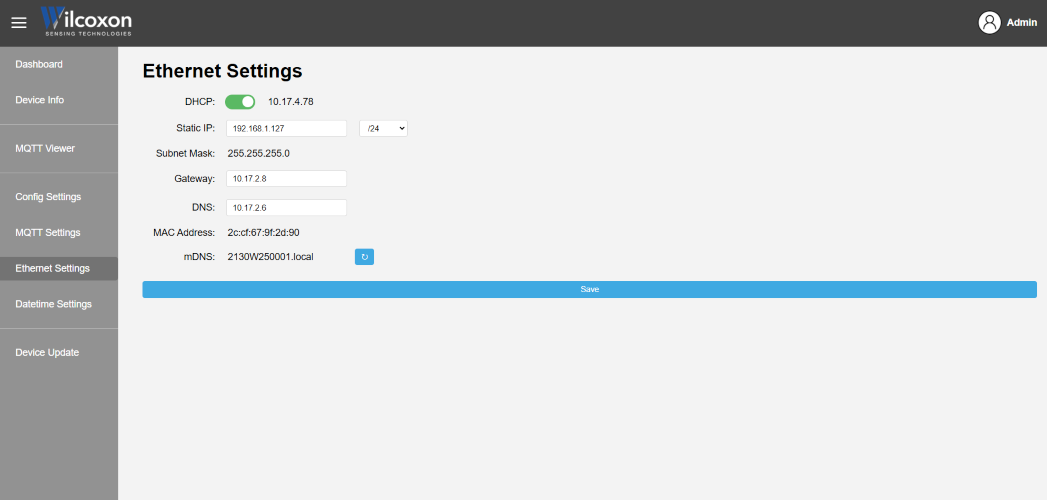
VDS130 Device Center: Ethernet Settings
FAQs
What types of sensors can I connect?
The VDS130 supports 4 IEPE accelerometers and 1 tachometer (RPM) input for applications requiring rotational speed reference.
You can configure:
• Sensor type (acceleration, velocity, displacement)
• Sensitivity (1–1000 mV/unit)
• Units (g, mm/s, etc.)
You can use Wilcoxon sensors, third-party sensors, or legacy installations.
What data does the VDS130 publish?
The VDS130 publishes:
Processed condition data
• Acceleration
• Velocity
• Displacement
• Crest factor
• True peak
Raw time waveform
FFT spectrum
All data is published in structured JSON over MQTT, ready for ingestion by:
• Asset management systems
• AI models
• Cloud dashboards
• Edge analytics
Can I view the data locally?
Yes. The built-in VDS Device Center provides:
• Live channel status
• Trend plots
• MQTT viewer (shows exactly what is being published)
• Configuration tools
This makes commissioning, troubleshooting, and validation simple — no external software required.
IEPE-to-Digital Advantage
Digital sensors play an important role in monitoring applications, but there are use cases where IEPE accelerometers provide greater diagnostic capability and signal quality. The VDS130 bridges those sensors into MQTT-based systems.
| Challenge | Typical Limitation | IEPE-to-Digital Advantage |
| Monitoring high-speed or high-frequency assets | MEMS sensors lose accuracy or bandwidth over ~5 kHz | Frequency response to 10 kHz for the ILA and 40 kHz for the VDS, providing richer diagnostic data |
| Low-amplitude vibration detection | MEMS noise floor limits low-level signal capture | IEPE sensors deliver superior low-noise performance for early-fault detection |
| Harsh industrial environments | MEMS often limited by temperature or packaging | IEPE sensors are field-proven for heavy-duty applications, extreme conditions, and hazardous locations |
| Mixed or legacy asset fleets | Customers have installed IEPE sensors that won’t connect to your digital infrastructure | Adapters digitize those existing sensors and stream the data into your platform over MQTT |


