What it is
A high power DC electronic load family in 150 V, 600 V, and 1,200 V models from 4 kW to 6 kW, with Turbo mode to 1.5 times rating and up to 8 units paralleled for a maximum of 48 kW.
Nine models cover battery, EV charger, and charging station testing in a 4U chassis. Four battery discharge modes, a dedicated BMS test mode, surge and inrush testing, and automated OCP and OPP tests are built in, with GPIB, RS-232, USB, and LAN for remote control.
- Nine models: 150 V, 600 V, and 1,200 V at 4 kW, 5 kW, and 6 kW
- Turbo mode: up to 1.5 times rated current and power for a short period (to 9 kW and 900 A)
- Maximum power up to 48 kW with up to 8 units connected in parallel
- Operating modes: CC, CR, CV, CP, CV + current limit, CV + power limit, and dynamic
- Four battery discharge modes with stop by voltage, time, or capacity (AH or WH)
- BMS test mode for Battery Management System board SHORT, OCCP, and OCDP tests
- Dynamic minimum rise time: 25 µs typical, slew rate to 24 A/µs
- Surge and inrush current test modes, plus automated OCP and OPP tests
- Built-in slow starter on the 600 V and 1,200 V models
- Compact: 6.97 × 17.32 × 29.33 in (177 × 440 × 745 mm), from 70.5 lb (32 kg)
- Interfaces: GPIB, RS-232, USB, and LAN
What it is used for
Some of the use cases for the PEL-5000G Series include:
- Electric vehicle batteries and chargers — including charging stations
- Battery discharge testing — by cut-off voltage, discharge time, or capacity
- BMS board verification — short circuit, overcurrent charge, and overcurrent discharge protection
- Fuse, breaker, and protection testing — using Turbo mode for short, OCP, and OPP tests
- R&D quality control and production testing, etc.
What does the PEL-5000G Series do?
The GW Instek PEL-5000G series single-channel electronic load provides 150 V, 600 V, and 1,200 V models with a power range of 4 kW to 6 kW. PEL-5000G has a total of 9 models featuring different combinations of power, voltage, and current. It can test and verify the specifications of batteries, electric vehicle chargers and charging stations, and electric vehicle batteries. PEL-5000G supports parallel connection for the same voltage specification across different power models, and up to 8 units can be connected in parallel to provide a maximum power of 48 kW.
For the scenario of battery charger testing, PEL-5000G specifically provides four battery discharge modes, namely CV + current limit test mode, CV + power limit test mode, CC mode, and CP mode. Users can choose a suitable test mode according to the test requirements.
For the battery discharge function, users can set the discharge cut-off voltage, discharge time, or discharge capacity (Ah) in CC or CP mode to meet the battery testing requirements.
In order to meet the verification requirements of different DUTs, PEL-5000G provides a variety of test functions, including surge current test mode, automated OCP and OPP test functions, and a parameter storage function. The 1,200 V model of PEL-5000G not only provides full power output at 1,000 V, but also provides 60% power output at 1,200 V output, which is higher than the 50% power output of other manufacturers of similar electronic loads.
High-voltage batteries or chargers directly connected to the electronic load may cause damage to the electronic load. PEL-5000G has a built-in slow starter, which not only protects the DC load, but also saves the user's installation cost and setting time for measurement on 600 V and 1,200 V models.
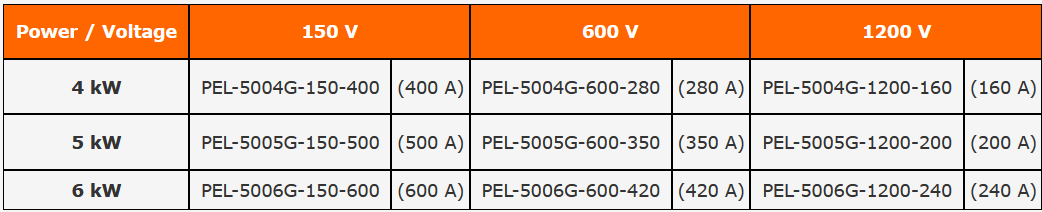
The communication interfaces supported by PEL-5000G include GPIB, RS-232, USB, and LAN. The power, voltage, and current of each model are shown in the following table.
Why engineers pick it
- Headroom when the test demands it. Turbo mode delivers 1.5 times rated current and power for short periods, so a 6 kW unit covers 9 kW short, OCP, OPP, surge, and BMS tests.
- Built for battery management boards. The BMS test mode measures short, overcurrent charge, and overcurrent discharge protection with step times down to 0.05 ms and ±0.02 ms measurement accuracy.
- Fast transients. Dynamic minimum rise time is 25 µs typical, with slew rate accuracy of ±5% of setting.
- More usable power at 1,200 V. The 1,200 V models give full power to 1,000 V and still deliver 60% power at 1,200 V, against the 50% typical of comparable loads.
Which PEL-5000G model do I need?
| Power (normal / turbo) | 150 V | 600 V | 1,200 V |
| 4 kW / 6 kW | PEL-5004G-150-400 (400 A / 600 A) | PEL-5004G-600-280 (280 A / 420 A) | PEL-5004G-1200-160 (160 A / 240 A) |
| 5 kW / 7.5 kW | PEL-5005G-150-500 (500 A / 750 A) | PEL-5005G-600-350 (350 A / 525 A) | PEL-5005G-1200-200 (200 A / 300 A) |
| 6 kW / 9 kW | PEL-5006G-150-600 (600 A / 900 A) | PEL-5006G-600-420 (420 A / 630 A) | PEL-5006G-1200-240 (240 A / 360 A) |
The model number gives power, rated voltage, and rated current: PEL-5005G-600-350 is 5 kW, 600 V, 350 A. Pick the voltage class that covers the DUT, then the power. Every unit has two current ranges, Range I at one tenth of Range II, so the smaller range resolves finer current on low-level measurements.
When is the PEL-5000G the wrong choice?
- Continuous power above 6 kW. Turbo mode is for short periods only. For continuous higher power, the PEL-5000C Series runs 8 kW to 24 kW per unit.
- Sources below the minimum operating voltage. The 150 V models need 0.7 V at full current, the 600 V models 10 V, and the 1,200 V models 15 V.
- Full power at 1,200 V. The 1,200 V models deliver rated power to 1,000 V and 60% of rated power at 1,200 V.
- Mixing voltage classes in parallel. Parallel operation requires the same voltage specification; only the power rating may differ.
- Hot environments. Operating temperature is 32 … 104 °F (0 … 40 °C).


