Hotspot Image
Talk to our Engineers

Need Real Answers for your Specific Use Case? Talk to our Engineers

No sales scripts. Just technical feasibility:

Call us at 1-866-400-1300

or

E-mail

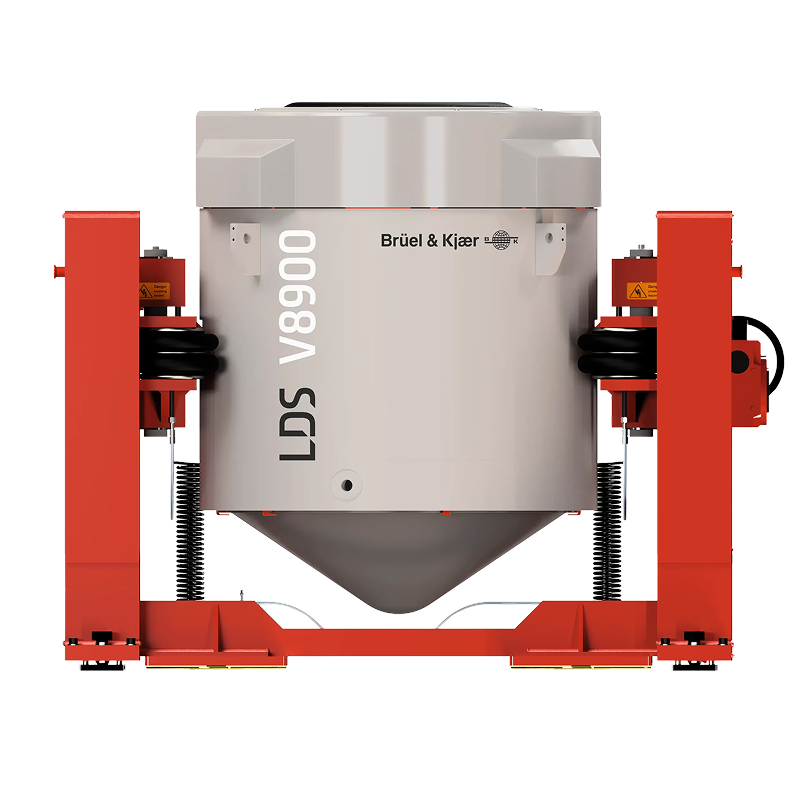
LDS V8900

LDS Vibration Test Systems

Generating/Updating Your Configure-to-Order tool...

See product documents

1

The W5 Engineering Advantage

Icon for award

20+ Years in Testing

Icon for users

All Across North America

Icon for trust

Trusted by Industry Leaders

Icon for clock

24-Hour Engineering Replies

Icon for users

Secure Order Processing

Icon for Award

ISO-Level Quality Assurance

Overview
Specifications
Resources

What it is

The LDS V8900 is a high-force electrodynamic shaker rated at 80.0 kN (17,984 lbf) sine force. It is built for vibration and mechanical testing with sinusoidal, random, or transient excitation. A 440 mm (17.3 in) armature delivers 101.6 mm (4.0 in) of displacement and supports payloads up to 800 kg (1,763 lb) internally. It runs from 5 Hz to 3,000 Hz and is driven by the LDS XPA88K or XPA128K power amplifier. The body sits in a Lin-E-Air trunnion mount with a body rotation gearbox. The shaker can also be paired with a horizontal hydrostatic slip table for combo vertical and horizontal testing.

  • Sine force: 80.0 kN (17,984 lbf) peak
  • Random force: 76.2 kN (17,130 lbf) rms
  • Half-sine shock force: 174.8 kN (39,297 lbf) with XPA88K; 254.1 kN (57,124 lbf) with XPA128K
  • Acceleration: 100 gn sine peak; 70 gn random rms
  • Velocity: 1.8 m/s (70.9 in/s) full field; 2.5 m/s (98.4 in/s) reduced field
  • Displacement: 101.6 mm (4.0 in)
  • Usable frequency range: 5 Hz to 3,000 Hz
  • Internal load support: 800 kg (1,763 lb)
  • Overturning moment restraint: 3.0 kN·m (26,552 lbf·in)

At a glance

80 kN (17,984 lbf) sine force — air-cooled, no water plant to install or maintain

76.2 kN (17,130 lbf) random rms; half-sine shock to 254.1 kN peak with XPA128K amplifier

101.6 mm (4.0 in) stroke, 5–3,000 Hz usable range — sine, random, and shock in one machine

Hydrostatic bearing: 3.0 kN·m (26,552 lbf·in) overturning moment — no guided head expanders needed

440 mm (17.3 in) armature, 1,800 Hz resonance; Lin-E-Air non-contact, non-optical centring system

800 kg (1,763 lb) internal load support; trunnion-mounted or combo with LDS HBT slip table

Sinusoidal

80 kN — swept to 3,000 Hz

Swept-sine resonance search and dwell to 80.0 kN (17,984 lbf) peak and 100 gn for qualification and fatigue across the full 5–3,000 Hz band.

Random

76.2 kN rms, 70 gn

Aggressive large-payload PSD to 76.2 kN (17,130 lbf) rms for environmental qualification and durability testing of complex assemblies.

Shock / transient

Half-sine to 254.1 kN peak

Two-millisecond half-sine transients to 254.1 kN (57,124 lbf) peak with the XPA128K for avionics, defense, and shock-class programs.

What it is used for

Some of the use cases for the LDS V8900 include:

  • Sine testing: swept and dwell sinusoidal testing at up to 80.0 kN (17,984 lbf) and 100 gn.
  • Random vibration testing: random profiles at up to 76.2 kN (17,130 lbf) rms and 70 gn rms.
  • Classical shock testing: 2 ms half-sine shock pulses at up to 254.1 kN (57,124 lbf) with the XPA128K amplifier.
  • Low-frequency, long-stroke testing: profiles that need the 101.6 mm (4.0 in) displacement and velocity up to 2.5 m/s (98.4 in/s) in reduced-field mode.
  • Heavy and offset payloads: payloads up to 800 kg (1,763 lb) on the internal load support, with 3.0 kN·m (26,552 lbf·in) of overturning moment restraint for offset centers of gravity.
  • Vertical and horizontal testing: rotating the body in its trunnion, or pairing the shaker with a horizontal hydrostatic slip table in a combo system.

Key features

  • Hydrostatic armature bearing: the moving element runs on a hydrostatic bearing fed by the shaker hydraulic unit, giving 3.0 kN·m (26,552 lbf·in) of overturning moment restraint and 28.6 kN/mm (163,310 lbf/in) of suspension cross-axial stiffness.
  • Lin-E-Air trunnion mount: the body rides on Lin-E-Air suspension with a body resonance below 5 Hz. A body rotation gearbox turns the shaker from vertical to horizontal.
  • Internal load support: an air-supplied internal load support carries up to 800 kg (1,763 lb) of static payload. Load support pressure is shown at the pedestal control unit.
  • Two armature insert patterns: 17 or 29 raised stainless-steel inserts in M8, M10, or 3/8 UNC, on pitch circles from 101.6 mm (4 in) to 406.4 mm (16 in).
  • Full-field and reduced-field operation: full field for maximum force, reduced field for velocity up to 2.5 m/s (98.4 in/s).
  • Air-cooled: a dedicated cooling fan moves 1.75 m³/s (3,708 ft³/min) through the shaker, with an optional silencer.
  • Quiet mode: the system can run with the cooling fan switched off for short periods at low force to minimize acoustic noise.
  • Low stray field: under 1.5 mT (15 gauss) at 150 mm (6 in) above the table, full field.
  • Pedestal control unit: one station for emergency stop, Lin-E-Air and load support controls, and armature position and load support pressure indicators, linked to the amplifier over CANbus.

Why engineers pick it

80 kN in an air-cooled system. The V8900 reaches 80.0 kN (17,984 lbf) sine force using a dedicated cooling fan, and its site supply list is limited to 3-phase power and compressed air.

Built for payloads that aren't centered. 3.0 kN·m (26,552 lbf·in) of overturning moment restraint and high cross-axial and rotational suspension stiffness keep the armature on-axis with offset payloads.

Heavy payloads without external support. The internal load support carries 800 kg (1,763 lb) statically, so heavier test articles don't consume the shaker's dynamic force just holding position.

Long stroke for low-frequency work. 101.6 mm (4.0 in) of displacement and a usable range starting at 5 Hz cover low-frequency profiles that shorter-stroke shakers can't reach at level.

Scalable shock capability. The same shaker delivers 174.8 kN (39,297 lbf) of half-sine shock force with the XPA88K or 254.1 kN (57,124 lbf) with the XPA128K.

The typical V8900 system

A complete V8900 test system includes:

  • LDS XPA88K or XPA128K amplifier: a switching amplifier with 93% module efficiency, 20 Hz to 3,000 Hz full-power bandwidth, and 100 V rms rated output.
  • Vibration controller and data acquisition unit: they close the loop from accelerometer feedback on the armature or payload.
  • Pedestal control unit: emergency stop, Lin-E-Air, load support, and armature position control.
  • Shaker hydraulic unit: oil supply and return for the hydrostatic bearing. It is always required.
  • Cooling fan and starter box: 50 Hz or 60 Hz fan, with an optional silencer.
  • Slip table hydraulic unit: added for combo systems with a horizontal slip table.

Site requirements

  • Power: the amplifier, shaker hydraulic pump, and cooling fan starter box each need a 3-phase supply of 380 to 480 V, 50/60 Hz. The controller, data acquisition unit, and pedestal control unit each run on a single-phase supply of 110 to 250 V, 50/60 Hz. Total steady-state electrical requirement is 126.15 kVA.
  • Compressed air: 6.9 bar (100 psi) to the pedestal control unit for Lin-E-Air and load support.
  • Ambient: shaker +7 to 30 °C (+45 to 86 °F); amplifier +5 to 30 °C (+41 to 86 °F).
  • Heat and airflow: plan for heat rejection from the cooling fan and amplifier, and for fan acoustic noise of 106 dBA at 1 m (3.3 ft). An acoustic enclosure for the cooling fan is not available from Brüel & Kjær and should be sourced locally if needed.

Configuring and scaling

Select the V8900 on this page and use Request Quote to start your system. Contact W5 for configuration choices the selector doesn't cover:

  • Amplifier: XPA88K, or XPA128K for higher shock force.
  • Armature insert pattern and thread: 17 or 29 inserts; M8, M10, or 3/8 UNC.
  • Combo system: adding a horizontal hydrostatic slip table. Combo performance is quoted separately from the trunnion-mounted ratings.
  • Cooling fan: 50 Hz or 60 Hz, with or without the silencer.
  • Thermal management and plinth cover kit: optional.

Frequently asked questions

Sinusoidal, random, and transient (shock) excitation from 5 to 3,000 Hz. A single V8900 covers qualification sine sweeps, random PSD durability, and high-acceleration half-sine shock — one machine for every test regime.

80 kN (17,984 lbf) sine peak, 76.2 kN (17,130 lbf) random rms, and half-sine peak shock to 174.8 kN (39,297 lbf) with the XPA88K or 254.1 kN (57,124 lbf) with the XPA128K. Random and shock ratings assume an m40 payload per ISO 5344 with a 2 ms pulse.

Air-cooled. The V8900 uses a dedicated cooling fan (1.75 m³/s airflow) and delivers water-cooled-class force without a water plant — no infrastructure to install, power, or maintain.

Yes. The hydrostatic bearing provides 3.0 kN·m (26,552 lbf·in) of overturning moment restraint, stabilizing offset-CG payloads on the armature without guided head expanders, rollers, or flexures.

Both drive the V8900. The XPA88K (88 kVA) delivers 174.8 kN peak shock; the XPA128K (128 kVA) raises that to 254.1 kN. Choose the XPA128K when shock capability drives the requirement. Contact W5 with your test profile for a recommendation.

5 to 3,000 Hz. Force is reduced above 2,200 Hz depending on payload and fixture dynamic response — account for this in test profiles at the upper end of the band.

Yes — as a combo system with the LDS HBT hydrostatic slip table. The combo adds a horizontal slip table and a dedicated hydraulic unit for horizontal-axis testing. Contact W5 for combo performance figures.

Get the V8900 specified, installed, and supported

W5 Engineering is the authorized North American distributor for LDS / Brüel & Kjær. We configure the V8900 to your force, shock, and payload targets — then install it and support it. One PO covers the shaker, amplifier, ancillaries, and commissioning. Contact us with your test profile and we will return a configuration recommendation, amplifier selection, and quote.

LDS V8900