What it is
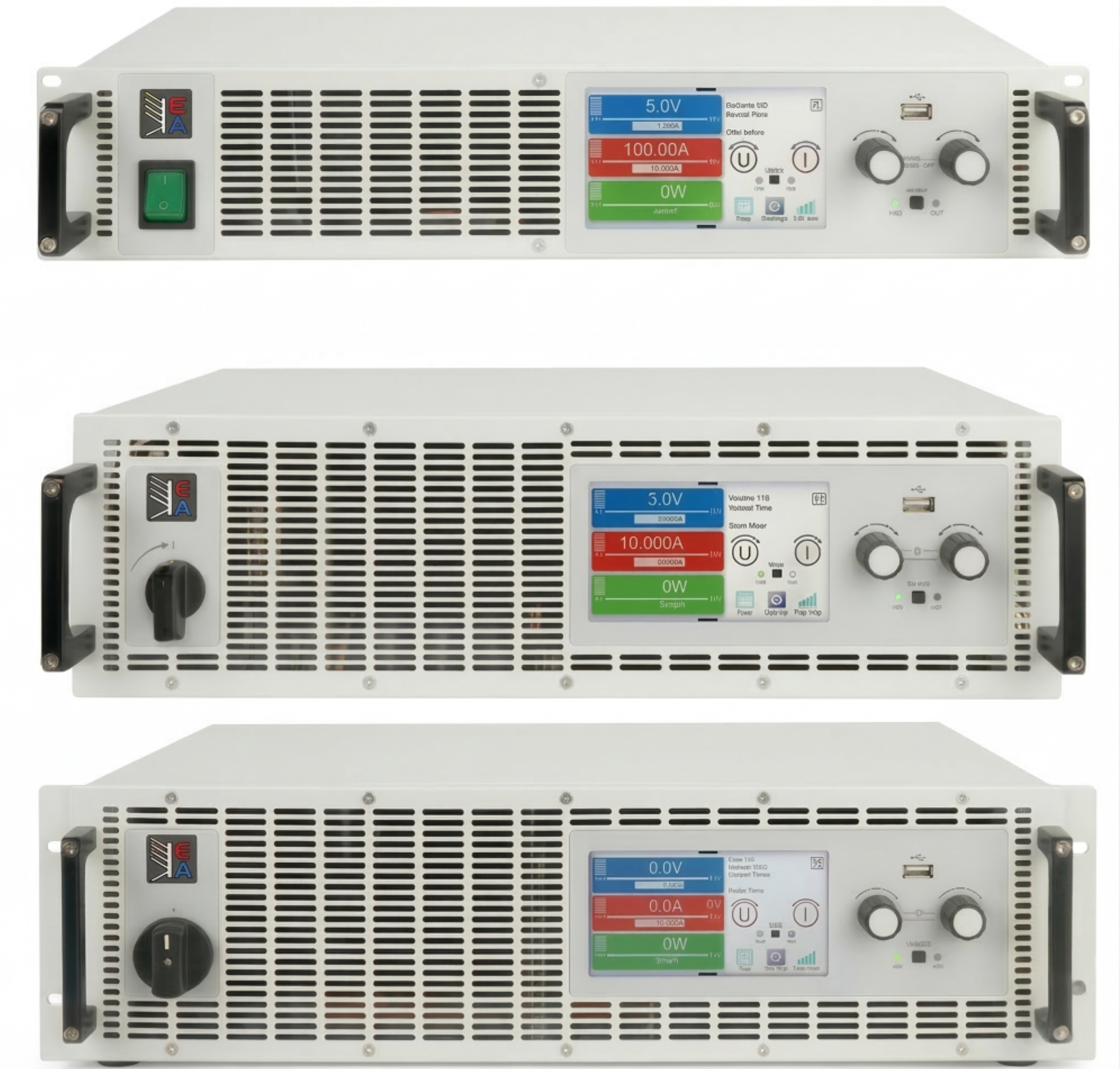
The EA-PSI 10000 is a programmable DC power supply with an integrated function generator that converts grid power into a regulated DC output at an efficiency of up to over 96%. Its flexible, power-regulated autoranging output holds full power across a wide voltage and current window, and the built-in function generator adds waveform, PV, and fuel-cell simulation plus predefined automotive test procedures. The series spans three rack-mount builds — a single-phase 2U at 1.5 kW and 3.0 kW, a three-phase 3U at 5, 10, and 15 kW, and a three-phase 4U at 30 kW — that share the same control, protection, function-generator, and parallel-connection architecture.
- Programmable DC power supply with integrated function generator, source output, autoranging
- 1.5 kW to 30 kW per unit across 2U, 3U, and 4U builds
- DC voltage ranges from 0–60 V up to 0–2000 V
- DC current ranges from 0–6 A up to 0–1000 A
- Efficiency up to over 96%
- Active power factor correction, typical 0.99
- Regulation modes CV, CC, CP, CR with fast crossover
- 16-bit ADCs and DACs with selectable control speed (Normal, Fast, Slow)
- Integrated function generator with predefined curves; PV (DIN EN 50530) and fuel-cell simulation
- Predefined automotive test procedures for LV123, LV124, and LV148
- Color 5 in TFT display with touch control
- Parallel operation of up to 64 units for systems to 1920 kW and 64000 A
- Command languages and drivers: SCPI, ModBus, LabVIEW, IVI
What it is used for
Some of the use cases for the PSI 10000 include:
- Relay test in production — defined voltage and current for coil and contact tests, with exact dynamic control of voltage, current, power, and resistance and diverse interfaces to integrate into an automatic test system without additional measuring equipment
- Solar array simulation — PV inverter testing with simulation models to EN 50530 or Sandia, including irradiation, shadow, temperature, clouds, and rain, with static or dynamic MPPT, and results documented to an Excel file
- Fuel cell simulation — simulate cells, modules, or packs; used as a source the supply also protects the connected component, with overcurrent protection acting like a safety fuse and voltage monitoring that triggers functions and alarms
- On-board charger (OBC) test — sequencing and logging generate reproducible test data, and the selectable Normal/Fast/Slow control speed avoids competition between the supply's control loop and the DUT's
Source and control
Autoranging output. The flexible, power-regulated output stage delivers full rated power across a wide range of voltage and current combinations, so a single unit addresses many operating points instead of a fixed rectangular envelope. Active PFC and the wide input let the units run on the majority of global grids, adjusting automatically to the available supply.
Digital regulation and programming. Regulation runs at 16-bit resolution on the ADCs and DACs, with CV, CC, CP, and CR modes and fast crossover, and a selectable control speed (Normal, Fast, or Slow) to match the dynamics of the device under test. The units are driven over SCPI and ModBus with LabVIEW and IVI drivers, and controlled through EA-Power Control software, from a color 5 in TFT touch display.
Function generator and simulation. Every model carries a function generator for sine, triangle, square, and trapezoid waveforms, plus ramp and arbitrary generators for freely programmable voltage and current progressions, with test sequences that can be saved and reloaded. A lookup table stores IU and UI reference lines, and adaptable tables support photovoltaic simulation to DIN EN 50530 and fuel-cell simulation. Predefined automotive test procedures cover LV123, LV124, and LV148.
Interfaces. Standard built-in interfaces are galvanically isolated: USB, Ethernet (100 Mbit), a front-panel USB host for data acquisition, and a 15-pole D-Sub analog interface for input/output, control, and monitoring at 0–5 V or 0–10 V. An optional industrial interface fits the plug-and-play slot: CAN, CANopen, RS232, Profibus, EtherCAT, Profinet, Modbus, or Ethernet, with one or two ports.
Why engineers pick it
Test intelligence built in. An integrated function generator, PV (EN 50530) and fuel-cell simulation, and predefined LV123/LV124/LV148 automotive procedures put much of the test system inside the instrument, reducing external instrumentation for PV inverter, fuel-cell, and automotive work.
One unit covers a wide test envelope. Autoranging delivers full rated power across a broad voltage and current range rather than at one fixed operating point, widening the field of working compared with a traditional supply.
Precise, dynamic control. 16-bit ADCs and DACs, CV/CC/CP/CR with fast crossover, and a selectable control speed give the exact, reproducible set-point and measurement behavior these applications demand.
It scales without changing the measurement chain. The same series parallels from a single unit up to a 1920 kW, 64-unit system on the Master-Slave and Share-Bus, so a platform grows without changing control philosophy or drivers.
Configuring and scaling
The series resolves along build, model, and options.
- Build sets form factor, phase, and power per unit — a single-phase 2U at 1.5 kW and 3.0 kW, a three-phase 3U at 5, 10, and 15 kW, and a three-phase 4U at 30 kW.
- Model sets the voltage-and-current envelope, from 0–60 V up to 0–2000 V and 0–6 A up to 0–1000 A. Each model carries its own article number.
- Options cover water cooling in stainless steel (4U), separately available US208V models that deliver full rated power on a 208 V grid (3U), and the optional industrial interface fitted to the plug-and-play slot.
For higher power, units parallel on the Master-Slave and Share-Bus: up to 64 units combine into one system providing up to 1920 kW and 64000 A, behaving as a single unit with total power and current shown on the master and load shared equally. Different power classes can be mixed provided the voltage class stays constant — for example, a 75 kW system from two 30 kW units and one 15 kW unit — and a 19-inch 42U cabinet reaches up to 240 kW in roughly 0.6 m² (6.5 sq ft) of floor space.
Configure your unit on this page and buy it directly. For paralleled multi-unit or multi-cabinet systems, the water-cooling build, US208V models, a specific industrial interface, or a full turnkey rack, contact W5 Engineering and we will scope it with you.